Saturday, March 17, 2012

(G2,G3) Experiments in Weaving


For this project we decided to look at pictures of medieval tapestries and learned how tapestries were made
by weaving threads together on a loom.
We used a tapestry template and practiced weaving by "warp" threads in tension, so "weft" threads 
can be woven back and forth between them.
On of the most important tapestries in Europe are a series of seven called "The Hunt of the Unicorn" dating from 1495-1505. These seven tapestries illustrate the sequence of the hunt, ending with the capture of the unicorn.


We glued a fabric sheet on the template to represent the appearance of the dying wool.
Dyes were made from berries, roots and fruit. The colors most often used were
yellow, red, and blue. 


Students added medieval imagery to the background. 


Using metallic fabric to illustrate that old metallic thread was used in medieval
tapestries. 


We discussed how tapestries were an art form of their own like paintings or sculpture.
Images of animals, people, and plant-life were depicted in vivid color and detail.


Using a variety of fabric to illustrate the richness of the design in the tapestries. 


Saturday, March 10, 2012

(KG) The Kandinsky Project/Emphasis on Lines and Shapes (Part II)

This part of the Kandinsky project was divided into two sections.
I. In section one, the students worked in groups of four to create Kandinsky compositions
by using pre-cut paper of shapes and lines. 
II. In section two, the students worked individually to create their own Kandinsky-based artwork.
Each student used two sheets of water color paper; one sheet was painted with water colors and it was used for the background. The second sheet was also painted with different water colors, and it was cut
into a variety of lines and forms. Students also used black paper to highlight their colorful
compositions.


Working together and discussing the work of the artist was part of the process.
We discussed the meaning of the word abstract in relation to Kandinsky's work.


Incorporating shapes and lines as seen in Kandinsky's artwork, yet
creating our own original compositions.


The letter "W" stands for the first letter in his name (a group project).


Kandinsky- Unfinished painting, 1944
Students discussed the absence of colors in the composition.


We discussed how in Kandinsky's works we see a combination of biomorphic forms
and  geometric lines (a group project).

Kandinsky - Composition VIII,1923


Letter "K" and the image of the grid design (a group project). 


Using water colors to paint our shapes and lines.


Saturday, March 3, 2012

(G1) Sunflowers (A work in progress) Part I

We studied Vincent Van Gogh's sunflowers. Students identified the colors, shapes and textures in his artwork.
For this lesson, we learned how to draw sunflowers. Students practiced drawing different types of sunflowers before deciding on the one they liked the best.  


Saturday, February 25, 2012

(KG) The Kandinsky Project/ Emphasis on the colors ( Part I)


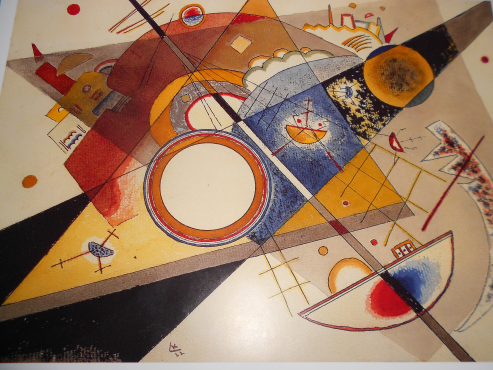
Kindergarten students studied the work of Wassily Kandinsky.
Wassily Kandinsky was one of the greatest pioneers of abstract art. 
We looked at his work and we discussed how to him, art was a means of expression
in which what one actually sees and what one feels are blended. In this first phase of the Kandinsky project, students studied the use of his colors and created colorful compositions.


Wassily Kandinsky
Squares with Concentric Rings 1913


Wassily Kandinsky


Wassily Kandinsky
Composition VIII 1923


Wassily Kandinsky
Blue Mountain 1908-09


Students used pencils to draw their design.
They used a variety of water colors to complete their compositions.


Wassily Kandinsky
Untitled 1922


This student concentrated in drawing and coloring "the little chicken" in
the lower left side of Kandinsky's composition.


Wassily Kandinksy
Graceful Ascent 1934


Wassily Kandinsky
Inclination 1931