Wednesday, February 16, 2011

(EV) Meeting Mr. Norval and learning about his work 2/5

We had the privilege of visiting with Mr. Norval.
He welcomed us in his studio and gave us a tour.


Mr. Norval explained how it feels to work with oils.
He demonstrated mixing different colors on his glass palette.


 Mr.Norval's glass palette.


The students are examining the artwork on the studio walls.


And of course every student had a favorite painting.


M. Norval is explaining about his inspiration for his paintings.
He made a painting of his neighbor's dog. 


Ms. Johnson, our Second grade teacher, and Ms. Clemson our Third and Fourth grade teacher are posing against Mr. Norval's wall.

(EV) (G2,G3,G4) Our visit to Artspace ( Meet the artists in their studios) 1/5

Learning about the history of the building.
Artspace is located in a downtown Raleigh in the historic Sanders Ford building.
The Artspace facility was once the city's livery and later Sanders Ford Car Dealership.
The building is one hundred years old.


Discussing the scale of paintings.
Observing the variety of lines and the brightness of colors.


Understanding modern sculpture.
Discussing the 3-Dimensionality of the artwork.


This is not an ordinary lamp.
Discuss the different material that the artist incorporated in this artwork.


Looking at the details on the mixed media sculptures.  

Sunday, February 13, 2011

(G1) Collage with numbers and pictures ( A Connection of Art and Technology


Our Technology teacher Ms. Gillis helped us with finding the appropriate fonts in Technology class.
It was a challenging project but we were really happy with the results.

Project objective(s):
- Arrange numbers and pictures in a coherent way
- The effect of overlapping
- Use markers to create your own fonts


Lines create numbers.


We had and interesting discussion on how to create original compositions.


Adding details is part of the art process.


The importance of using markers correctly.


Ability to draw curvy, wavy and straight lines.


The careful choice of water colors enhances the composition.


Making corrections is part of the art process.


Working hard for the final details.

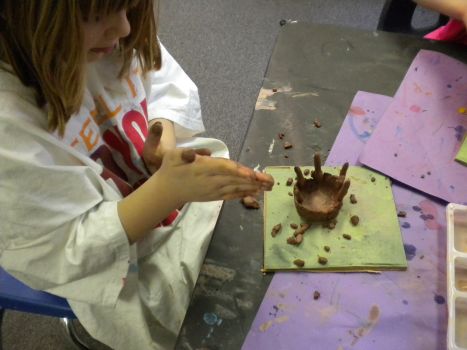
(G2) Learn how to make a pinch pot

Project objective(s):
- Learning about the properties of clay
- How to prevent cracks in your clay design
- Learning about the pinching method
- Your fingers are your best tools


Using the pinch method by squeezing clay between thumb and fingers.


Learning that clay dries fast.


Checking for even thickness in the walls of the pot.


Smooth cracks with moistened fingers.


Learning how to create coils.


And voila! My pinch pot is done.

(KG) Learning the properties of Clay

Project objective(s):
- Feel the texture of clay
- Use you fingers to create your free design
- Use tools to create details


Creating textures by using tools.


 Tools help with creating details in the design.


A big smile after the completion of the clay project!


Student comment: " I made a dog, a sun and the sky".


Student comment:  "I made a flower, a butterfly, the rain and the sun".


Student comment: "This is a microphone". 

(PS) The organic and geometric qualities in Joan Miro's artwork

Project objective(s):
- We will learn the difference between organic and geometric shapes
- The students will use both organic and geometric shapes to create imaginary creatures


A student is working in filling in the circles.


Using both primary and secondary colors in order to color the circles.
Practice color fencing.


Observing the difference between organic and geometric shapes.


Creating imaginary creatures by using both organic and geometric shapes.


Use your imagination to draw imaginary characters.


Drawing a guitar with four eyes!
Student comment:  "Miro's guitar does not have eyes" referring to Miro's picture: " The Harlequins Carnival"
Drawing a person with eleven feet while creating a pattern by using red and blue.


Student comment: " I drew the face of Joan Miro and wrote his name in my picture"
" His face is organic"


Sunday, February 6, 2011

(PS) Learn about the work of Joan Miro

Project objective(s):
- Look at the artwork of Joan Miro: "The Harlequins Carnival"
- Observe the overlapping of shapes in his artwork
- Examine the organic and geometric shapes
- Discuss the difference between organic and geometric shapes


Examining Miro's artwork: "The Harlequins Carnival"
Identify the different shapes found in his work


Examining the humor in his work
Finding the musical instruments, cats, insects, plants and strange looking creatures


Find the geometric shapes in his work


Find the guitar in the picture


Yes, we see a guitar in the picture.
Student comment:  "This is a real guitar, and it is bigger"


(G2) Create a Joan Miro picture

Project objective(s):
- Look at the work of Joan Miro: " The Harlequins Carnival"
- Observe the overlapping of shapes in Miro's artwork
- Examine the organic and geometric shapes
- Discuss the difference between organic and geometric shapes


Use both organic and geometric shapes to create an original composition


Use a variety of lines to complete your composition


Create interesting characters that tell a story to the viewer


Use markers correctly to complete your design


The use of both water colors and color pencils enhance the composition


Joan Miro would have been proud of our compositions