Showing posts with label abstract. Show all posts

Saturday, August 18, 2012

Using wood to create 3-Dimensional art (Part II)

For this part of wood exploration, the students used a variety of wood scraps in order to create a colorful composition.
The students also had the opportunity to explore the art of pyrography. We learned that pyrography can be translated as "writing with heat". We looked at pictures of the variety of pokers that artists use, and discussed how different temperature is applied to the heated area of wood in order to create dark lines and shading.
The students did a great job creating designs using the burner pen, and some of them even managed to write  their name.


Creating designs on a wooden surface was challenging.
The wood is not as smooth as a piece of paper and often absorbs paint faster.   
The pyrography experiment is placed in the middle of the composition.


 Learning how to hold the burner pen correctly was essential for this project.
We went over the safety procedures in detail.


We learned quickly that we can burn the wood if we remain on the same spot longer than needed.
Student comment: " I smell the wood burning".    


Practicing writing letters.


Saturday, March 10, 2012

(KG) The Kandinsky Project/Emphasis on Lines and Shapes (Part II)

This part of the Kandinsky project was divided into two sections.
I. In section one, the students worked in groups of four to create Kandinsky compositions
by using pre-cut paper of shapes and lines. 
II. In section two, the students worked individually to create their own Kandinsky-based artwork.
Each student used two sheets of water color paper; one sheet was painted with water colors and it was used for the background. The second sheet was also painted with different water colors, and it was cut
into a variety of lines and forms. Students also used black paper to highlight their colorful
compositions.


Working together and discussing the work of the artist was part of the process.
We discussed the meaning of the word abstract in relation to Kandinsky's work.


Incorporating shapes and lines as seen in Kandinsky's artwork, yet
creating our own original compositions.


The letter "W" stands for the first letter in his name (a group project).


Kandinsky- Unfinished painting, 1944
Students discussed the absence of colors in the composition.


We discussed how in Kandinsky's works we see a combination of biomorphic forms
and  geometric lines (a group project).

Kandinsky - Composition VIII,1923


Letter "K" and the image of the grid design (a group project). 


Using water colors to paint our shapes and lines.


Saturday, February 4, 2012

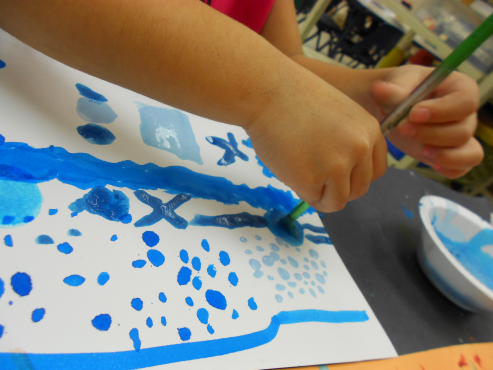
(G1) Winter Experiments

Learning how to create shades of blue.
Some students created winter landscapes, while others
mixed the color blue with clay to make a snowman. 
We discussed how the use of white was important for the creation of blue shades. 
We used a variety of brushes and observed the uniqueness of each  brushstroke.
The students had fun creating the colorful clothing for their snowmen.    

Student comment: " I am skating."


Student comment: " I made flowers under the snow."


Student comment: " I am fencing my flowers from the winter storm."


Student comment: " My snowman is happy."


Student comment: " It is a snowstorm."


Student comment: " This is a pirate snowman."


Student comment: " These blue worms are freezing."


Student comment: " My snow-girl is pretty." 


Student comment: " The four blue aliens are dancing in the snow." 


Student comment: " I love my lines and circles."


Student comment: " This  picture looks like my grandfather's farm."

Sunday, January 22, 2012

(KG) Creating in the style of Brice Marden


Students learned about the work of Brice Marden by looking at and discussing the meaning of gestural abstraction in his art.
Brice Marden traveled in Thailand in the 1980s, where he became interested in Far Eastern
calligraphy and the art of the brush stroke.


Brice Marden


Students used four different color pencils to create the
overlapping lines in their work.


Students learned how to use overlapping in their artwork to show that
something is in front or behind another object.


Brice Marden at work creating his brush stroke with a wooden stick. 


Brice Marden


Brice Marden


Brice Marden


Students were encouraged to create overlapping lines using yarn.


Brice Marden


We tried to hide the ends of the yarn.